
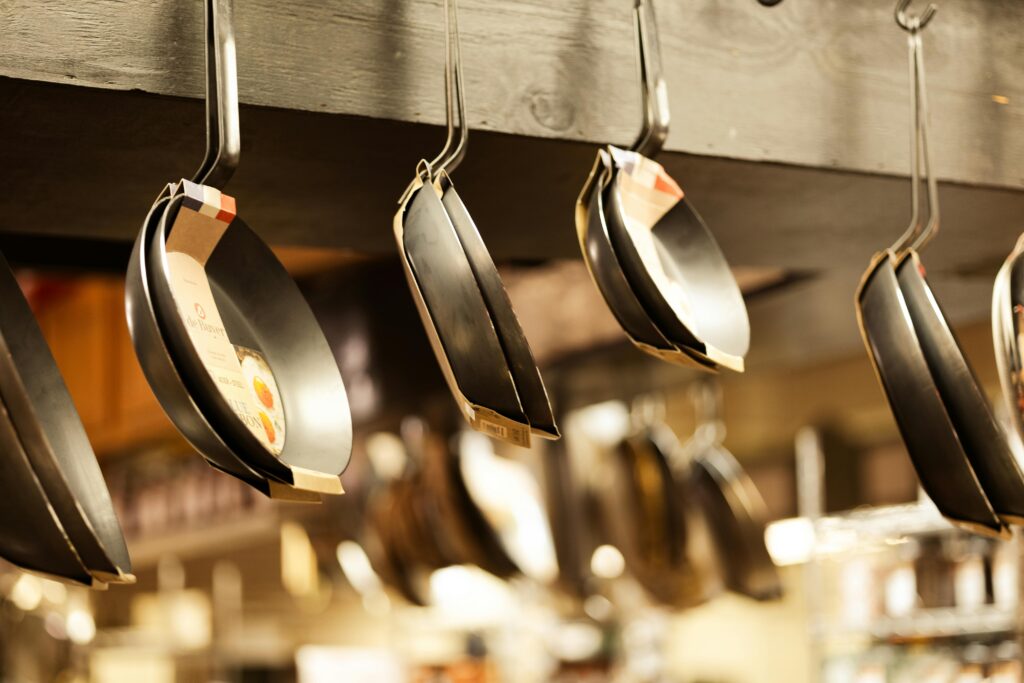
You don’t really notice your cookware when things are slow. It’s when you’re in the middle of a rush—tickets stacking, someone waiting at the counter, something about to overcook—that it shows.
In a busy café, speed isn’t always about moving faster. It’s more about not getting held up. Waiting on water to boil.
Fighting a pan that heats unevenly or stopping to deal with cleanup before you’re ready—that kind of stuff.
Some upgrades seem small at first. Then you use them during a busy shift and it clicks.
1. Tri-Ply Stainless Stock Pots
Stock pots are easy to overlook, but they do a lot. If you’ve used thinner ones, you already know the issue.
Heat isn’t even. One spot’s too hot, another’s lagging, and you’re adjusting constantly.
Tri-ply helps with that. It spreads heat better and holds it, so things stay more consistent.
It also recovers faster after you add ingredients, which is one of those things you don’t think about until you’re waiting on it.
If you’re comparing sizes or just trying to get a feel for what’s out there, you can look at the pots behind restaurant-scale soups and see the differences.
ROI note: Fewer burned spots, less adjusting, more consistency.
2. Perforated Inserts for Pasta and Steaming
This one’s pretty straightforward.
Instead of draining the whole pot, you lift the insert. That’s it. Pasta, vegetables, whatever—it’s quicker and there’s less mess.
It also cuts down on the juggling. You’re not carrying hot water across the kitchen or trying to line things up perfectly.
ROI note: Saves time in small ways that add up.
3. Rondeau Pans for Multi-Step Cooking
Rondeaus are kind of the in-between pan that ends up doing a lot.
They’re wide enough to sear properly, but still deep enough for sauces or braising. So instead of switching pans halfway through, you just stay where you are. During a rush, that’s one less thing to think about.
ROI note: Fewer pan swaps, less cleanup later.
4. Induction-Ready Sauté Pans
Even if you’re not using induction, these still help. They heat up fast and respond quickly when you change temperature, so you’re not waiting around or overshooting and trying to fix it.
It just feels a little more predictable, which matters when you’re cooking multiple things in the kitchen.
ROI note: Better control, fewer corrections.
5. Measuring-Mark Saucepans
This one seems minor, but it’s not.
Having measurements right in the pan saves a step. You’re not grabbing extra tools or double-checking amounts. You just… do it and move on.
It also helps when your station isn’t perfectly lit—which happens more than people admit. If you can actually read the markings at a glance, you’re not pausing or second-guessing mid-task. Even small lighting tweaks—like adjusting overhead placement or cutting shadows—can make a difference in how quickly you move through prep.
When you’re repeating the same tasks all day, that kind of thing adds up.
ROI note: Less back-and-forth, smoother prep.
6. Heavy-Gauge Sheet Pans With Racks
Sheet pans take a lot of use, so the difference shows up pretty quickly.
Lighter ones warp or cook unevenly. You end up rotating things more than you should. Heavy-gauge pans hold up better and stay consistent.
Add a rack and airflow improves, which helps with even cooking and cuts down on flipping.
ROI note: More reliable results, less checking.
7. Nonstick Fry Pans for High-Turn Items
Not everything needs to be stainless.
For eggs, pancakes, or anything delicate that’s on and off the heat quickly, a solid nonstick pan just makes life easier. Less sticking, less oil, less time spent scraping or redoing something that didn’t come out right the first time.
They don’t last forever, but that’s kind of the trade-off. When they’re in good shape, they speed things up in a way that’s hard to replace.
ROI note: Faster turnaround on high-volume items with less waste.
Cleaning Slows You Down More Than You Think
This part gets overlooked.
Some pans are fine until you have to clean them mid-shift. Food sticks, scrubbing takes longer, and now you’re waiting on something you just used.
Better cookware usually means easier cleanup. Not perfect, just… easier. And that keeps things moving.
Same idea with the space around you. Surfaces that wipe down quickly—stainless, sealed counters, even laminate flooring—save time in ways you don’t really notice until things get busy.
It’s not flashy, but it matters.
It’s Not About Replacing Everything
Most kitchens don’t swap everything out at once.
Usually it’s one or two things that keep getting in the way. The pot that takes forever. The pan that never heats right.
Start there.
You’ll notice the difference pretty quickly, especially during a busy shift.
If you like this kind of practical, behind-the-scenes kitchen stuff, check out the rest of our site for more ideas, upgrades, and small changes that make things run a little smoother day to day.
 Daniel Cartersonicser is the kind of writer who genuinely cannot publish something without checking it twice. Maybe three times. They came to diy renovation projects through years of hands-on work rather than theory, which means the things they writes about — DIY Renovation Projects, Home Improvement Strategies, Home Design Updates, among other areas — are things they has actually tested, questioned, and revised opinions on more than once.
That shows in the work. Daniel's pieces tend to go a level deeper than most. Not in a way that becomes unreadable, but in a way that makes you realize you'd been missing something important. They has a habit of finding the detail that everybody else glosses over and making it the center of the story — which sounds simple, but takes a rare combination of curiosity and patience to pull off consistently. The writing never feels rushed. It feels like someone who sat with the subject long enough to actually understand it.
Outside of specific topics, what Daniel cares about most is whether the reader walks away with something useful. Not impressed. Not entertained. Useful. That's a harder bar to clear than it sounds, and they clears it more often than not — which is why readers tend to remember Daniel's articles long after they've forgotten the headline.
Daniel Cartersonicser is the kind of writer who genuinely cannot publish something without checking it twice. Maybe three times. They came to diy renovation projects through years of hands-on work rather than theory, which means the things they writes about — DIY Renovation Projects, Home Improvement Strategies, Home Design Updates, among other areas — are things they has actually tested, questioned, and revised opinions on more than once.
That shows in the work. Daniel's pieces tend to go a level deeper than most. Not in a way that becomes unreadable, but in a way that makes you realize you'd been missing something important. They has a habit of finding the detail that everybody else glosses over and making it the center of the story — which sounds simple, but takes a rare combination of curiosity and patience to pull off consistently. The writing never feels rushed. It feels like someone who sat with the subject long enough to actually understand it.
Outside of specific topics, what Daniel cares about most is whether the reader walks away with something useful. Not impressed. Not entertained. Useful. That's a harder bar to clear than it sounds, and they clears it more often than not — which is why readers tend to remember Daniel's articles long after they've forgotten the headline.