
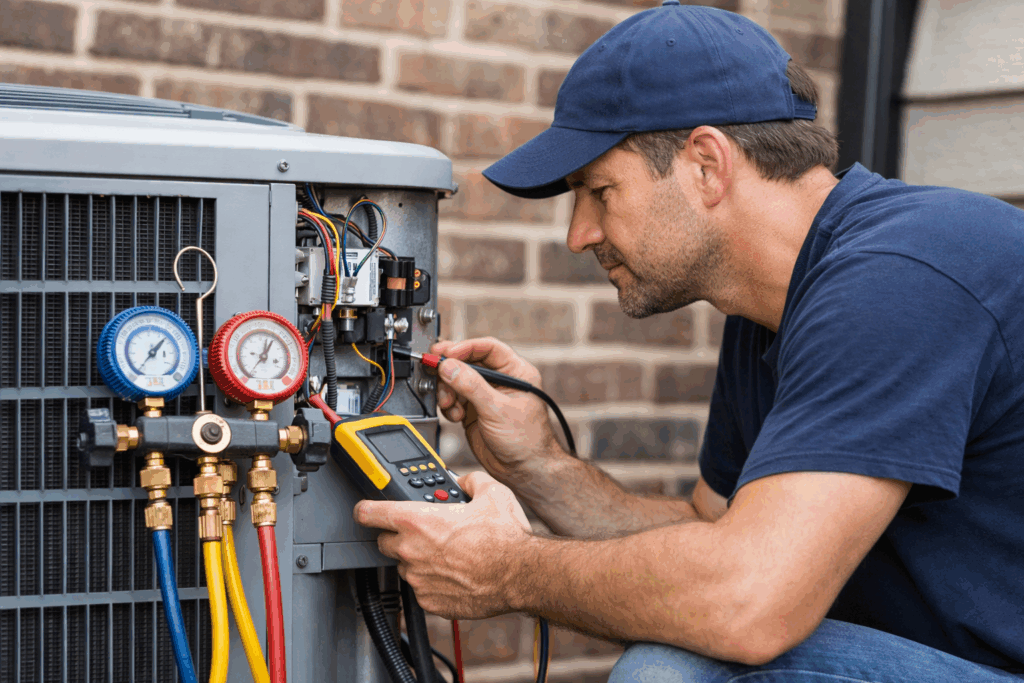
The moment your AC stops working, your brain jumps straight to worst-case scenarios. New unit. Thousands of dollars. Weeks without cool air. That panic is understandable, and it’s also exactly what some less scrupulous technicians are counting on.
Most AC problems are neither catastrophic nor expensive. But without knowing what to look for or what questions to ask, it’s easy to end up overpaying for a repair you didn’t need, or worse, replacing a system that had years of life left in it.
Finding a top-rated AC repair in San Diego can save you from these mistakes and ensure you’re getting the best service at a fair price. Here’s what you actually need to know.
The Symptoms Worth Knowing Before You Call Anyone
You don’t need to diagnose your AC yourself. But being able to describe what it’s doing, clearly and specifically, puts you in a stronger position when you’re talking to a technician.
A few of the most common patterns and what they usually point to:
- Not turning on at all usually starts with the simple stuff: thermostat set to “cool” rather than “fan only,” and a tripped circuit breaker. If both check out, the problem is most likely a failed capacitor or contactor – components that wear out over time and are generally inexpensive to replace.
- Warm air coming from the vents is often a refrigerant issue. If the refrigerant level is low, there’s a leak somewhere in the system. Recharging without finding and fixing that leak is a temporary fix that will cost you again within months.
- Short cycling (the system turns on, runs briefly, then shuts off and repeats) can signal anything from a dirty filter to a failing compressor. Start with the filter. If that’s not it, you need a technician.
- Banging or clanking sounds usually mean something has come loose inside the air handler. Hissing points to refrigerant. Clicking that continues past startup typically indicates a relay or capacitor issue.
Write down what you observed and when it started. That information alone saves diagnostic time and helps you evaluate whether the technician’s explanation makes sense.
Why the Technician You Choose Matters More Than the Repair Itself
A correct diagnosis by a qualified AC technician is worth more than any single repair. A wrong one, or a dishonest one, can cost you several times over.
The first thing to verify is EPA 608 certification. Federal law requires any technician handling refrigerants to hold this credential. It takes about 30 seconds to ask for and should not be a point of hesitation on their end.
Beyond that, pay attention to how they communicate. A good technician will tell you what they found, show you if possible, and explain why a specific repair is necessary before starting any work. They’ll give you a written estimate. They’ll itemize the invoice.
Red flags are usually obvious in hindsight: vague explanations, pressure to decide quickly, reluctance to put anything in writing, or a recommendation to replace the entire system without documented evidence of why repair isn’t viable.
The Myth That a Broken AC Always Needs to Be Replaced
This is one of the most persistent and costly misconceptions in HVAC repair: that an AC failure is a sign the whole system is done.
It usually isn’t. Most breakdowns come down to individual components, not systemic failure. Capacitors, contactors, fan motors, refrigerant leaks, control boards, these are all repairable. Even compressor replacements, while more expensive, are often still cheaper than a full system replacement.
The replacement conversation becomes legitimate when multiple major components have failed, when the system uses R-22 refrigerant (phased out federally in 2020, making parts increasingly scarce and expensive), or when the unit is old enough that its efficiency rating is significantly below current standards.
Outside of those situations, a technician recommending full replacement on a system under 12 to 15 years old without a thorough written diagnosis deserves a second opinion.
A Simple Framework for the Repair vs. Replace Decision
When you’re genuinely unsure whether to repair or replace, this formula gives you a starting point: multiply the estimated repair cost by the age of the unit in years. If the result is above $5,000, replacement is worth a serious conversation. Below that, repair almost always wins financially.
A realistic example: a 7-year-old unit needs a fan motor and capacitor replacement at $450. 7 x 450 = $3,150. Repair it without hesitation. An 18-year-old unit needs a compressor at $1,600. 18 x 1,600 = $28,800. That math points clearly toward replacement.
This isn’t a perfect science, but it strips out the emotion and gives you a number to anchor the conversation. If a technician is pushing replacement on a unit where the math clearly favors repair, ask them to explain the reasoning with specifics. A good one will. A bad one won’t have a convincing answer.
What Happens to Your Air Quality After a Repair
Most people focus entirely on whether the AC blows cold again. Few think to ask about what the repair process might have introduced into their air.
Any work involving the air handler, ductwork, or internal components can disturb insulation, dust, and debris that then circulates through the system. This is especially relevant in older units where buildup has accumulated over years. A well-executed HVAC repair includes checking that access panels are properly sealed afterward and that the system runs a full cycle before the technician leaves.
If the air smells musty or dusty after a repair, or if anyone in the household notices increased allergy symptoms in the days following, it’s worth a follow-up call. It’s not always the repair’s fault, but it’s a connection worth investigating rather than ignoring.
Beyond that, air conditioner repair that addresses airflow problems, like a clogged evaporator coil or blocked vents, often improves indoor air quality noticeably. Dust and humidity control both depend on the system running efficiently, so a good repair isn’t just about comfort. It affects the air you breathe every day.
The Right Repair Done Right Is Worth the Call
Most AC problems are fixable. Most costs are manageable. And most of the stress around air conditioner repair comes from not knowing what to expect, not from the problem itself.
Go in with a clear description of the symptoms. Verify credentials. Get everything in writing. Use the repair vs. replace framework before agreeing to anything major. And pay attention to how your home feels in the days after the work is done.
If your system is struggling, don’t wait for a complete failure to act. Small problems become expensive ones when they’re ignored through a full summer of heavy use. Get it looked at, ask the right questions, and you’ll almost always come out ahead.